Thoughts on Ultraviolet Grasslands
Logistics dnd

Luka Rejec, one of my favorite RPG creators, is currently offering The Vastlands Guidebook, his d20 OSR system, for free. Downloading and reading through this has been an occasion for me to revisit Ultraviolet Grasslands., a book that I’ve had for quite a while, to see if I might want to run a campaign or some adventures with it. UVG is a book that I find fascinating and puzzling in equal measures. Like many, I find myself drawn to the sheer scope and creativity of the project while being flummoxed when I consider how I would run it. So, I think unpacking what makes me simultaneously drawn and repelled to this book is worthwhile.
Weirdness Abounds
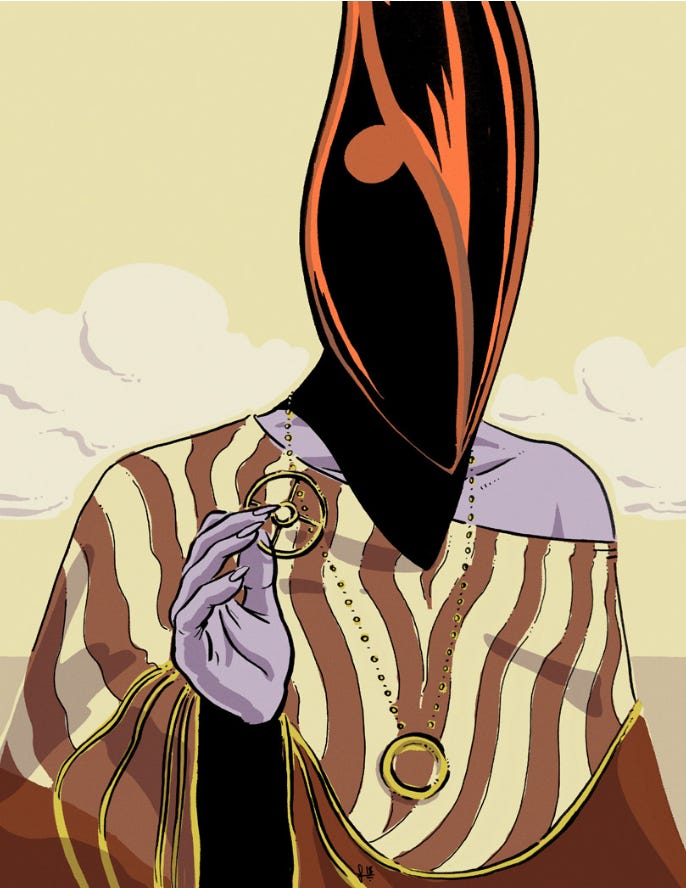
A post-post-apocalyptic setting, UVG is suffused a new-weird creativity that veers sharply from traditional fantasy. What first engages me, and probably most people, is Rejec’s fantastic Moebius-esque art. These pieces are simple, but colorful and inviting, and do a lot of work to establish the tone of the setting. The book is filled with Rejec’s strange landscapes and mysterious personae in a way that simply demands attention.


Meanwhile, his writing is enthusiastic and amusingly florid at times. I’m always a bit annoyed when non-native English speakers manage to be so adept and playful with the language, but maybe that’s what enables him to take risks, pulling together both obscure-but-real diction and real-sounding inventions together to suggest a world that is alien and yet derived from our own. Overall, one can’t help but be impressed by the scope and volume of his graphical and literary output.
and yet...
Everytime I read this book I have no idea how I would run it. Part of this is because Rejec favors anti-canon worldbuilding, such that much of what’s ‘going on’ in the setting are more suggestions than concrete and developed ideas. For example, jumping to a random page, we have a possible location
Savage Biomech Tribe (1 days, 144 xp).
Living in wicker and metal trenches and tunnels dug into the prairie, the machine-corrupted tribesmen (L2, resilient) have degenerated into pure savagery, kept alive by their self-repairing implants and hyper-normal reflexes. They have no culture to speak of, save an innate urge to bring blood and brains to their lord: the Emperor of Post-Humanity (L12, psionic), a pulsating, half-mad clump of bones, brain, and clattering teeth held together by machines in a chamber five levels down. Surrounded by ancient artifacts (€10,000, 2d6 sacks) and helped by a fully cybernetic uplifted ape named Cornelius (L6, fast as heck), the Emperor plots the next step in its galactic ambitions with a large table covered in bone figurines.
Evocative, but questions will soon arise that this short paragraph cannot cover. First, the ‘L_’ formatting refers to a simple table to gives 3 stats, an attack bonus, and a damage die to any adversary, but it’s not quite a statblock; the other descriptive elements, some of which show up as tags (’psionic’ etc) will have to be improvised. But also, who is the emperor? How and why do they exist? Is the GM supposed to invent the ‘trenches and tunnels’ that lead ‘five levels’ down to the emperor? In terms of their plotting, how do they relate to the world outside of them? How would a GM advance their faction clock? What do the ‘ancient artifacts’ do, aside from their value? (I love that all the prices are in euros, as if the currency was the one thing that survived the apocalypse).
In practice, what does this location look like at the table, if the GM is just using the book with not putting in a ton of prep? Probably a simple combat encounter with the tribesmen, with the GM improvising what their ‘hyper-normal reflexes’ look like in mechanic terms. Then a narrative cut scene of the characters descending 5 levels into the earth, maybe with some resource drain. Finally a psionic conversation with a weird bone-and-teeth thing and an ape, neither of whom can say anything that interesting or meaningful or that helps illuminate the world around the characters. Then the PCs either steal the ancient artifacts somehow or, more likely, they leave. Maybe they come back later with reinforcements, leaving it up to the GM to elaborate the situation (perhaps with a map, or maybe just through connecting this encounter to something else in the setting) so that the PCs have an opportunity to steal the generic ancient artifacts. In other words, when I run this location in my head, it’s evocative but shallow, a sort of setting tourism.
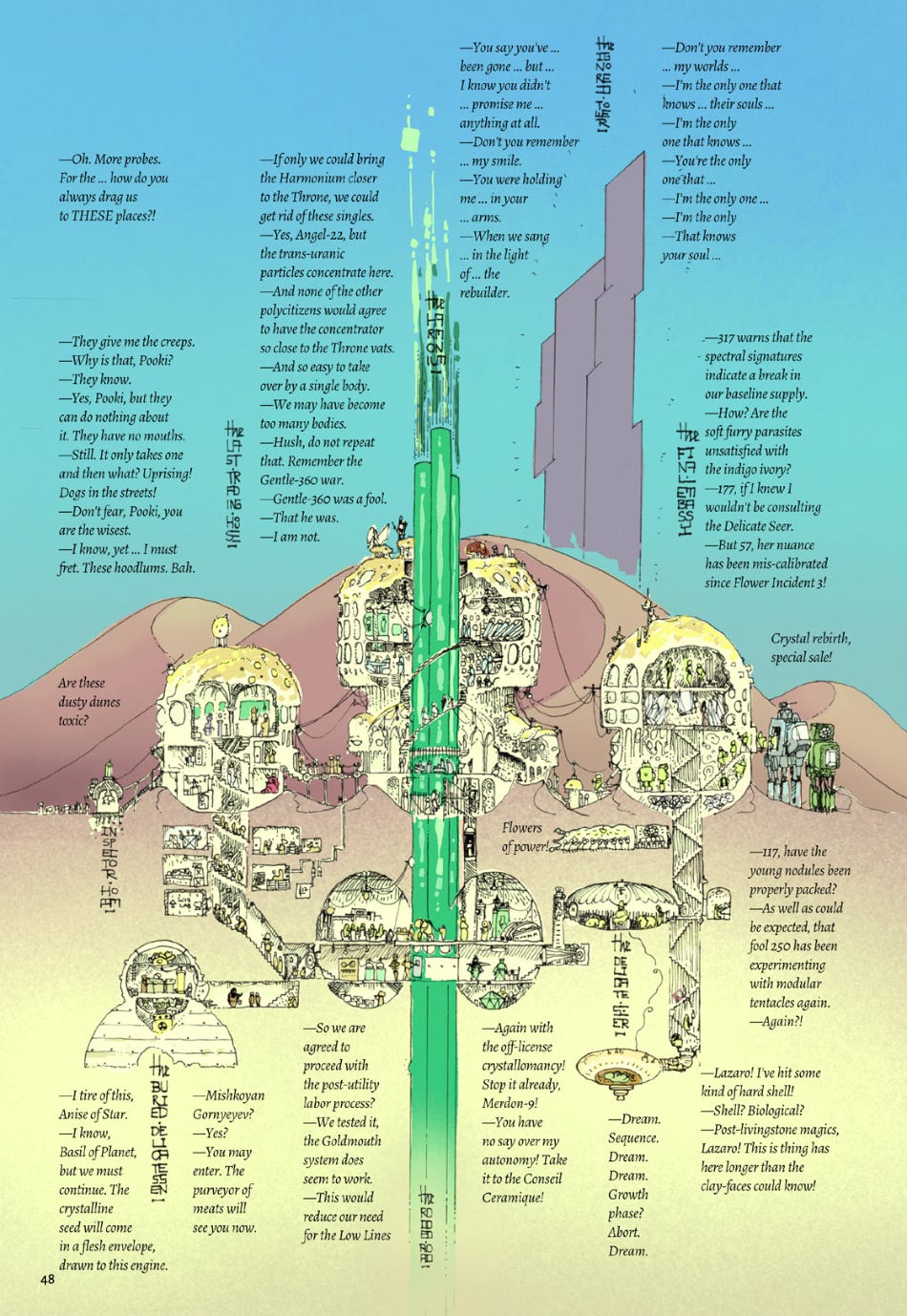
I followed Rejec’s patreon for much of the development of the Our Golden Age setting, but didn’t back the final product for this reason. It looks expansive and beautiful but quixotic and probably hard to use at the table.
Logistics Dnd
That said, upon revisiting UVG, another aspect of it struck me, one which is not really a criticism but does clarify what I like within OSR gaming. UVG really focuses on what I would call ‘logistics dnd.’ Again, this is not a criticism, as this is core to old school play. I actually recently asked the Between Two Cairns podcast a question about this and the ensuing discussion (around 13:00) was really interesting!
Basically, this is a style of dnd that really leans into the game being about treasure hunting. This is beyond the relatively small caches of coins and gems that motivate the ne’er-do-well low level adventurer to wander into the dungeon. This is more about the literal tons of difficult to move coins that older editions centered as the locus of play. Logistics dnd is about the economy-shattering wealth that lies levels below and miles away from safety, and in the repeated missions, hirelings, and specialized magic needed to transport that wealth back to ‘civilization.’ If everything functions as it should--a big if (see below)--the wealth not only levels up the party extra-diegetically but gives them the resources to make an imprint on the gameworld in the form of strongholds and other institutions. It facilitates, supposedly, the transition of the game into domain-level wargame.
On a revisit, it is clear that UVG is all about this kind of play. While every encounter is cloaked in an aesthetic of weird, ultimately the point of it all is to risk danger (in the form of combat or environmental hazard) to obtain valuable but very difficult to move goods. Thus (again flipping randomly) at the bottom of 300m-deep spring we might find “Offerings (€11,000 total) of bronze and gold and crystal, from swords to cannons. Each offering occupies 1d6-1 sacks and is worth €1d10 x 100.” Or you might find “a lost world of five interlinked chamber-cities eaten out of the mountain: glowing lumin trees (€750/fragile sapling, 1 sack), pendulous rare fruits, servant monkey-spiders (L2, chittering) suckling at the teats of milk trees (€350/sapling) and egg mass caskets (€1,000, 2 sacks each).” So the party figures out how to make multiple trips to the bottom of a spring to pull out bronze cannons, or they transport saplings from a lost world. Again, the setting is richly evocative, but beyond that, the gameplay here will be very particular and not to everyone’s tastes. I mean, would your players think to go deep spring diving in the off chance their are somewhat valuable bronze cannons at the bottom? Would they think of looting tree saplings in case they were valuable? It takes a particular kind of player to view every environment in terms of its strippable assets.
Instead of a stronghold, what this wealth enables in UVG is a more robust caravan (with more complex logistics), one that facilitates a journey finally to the end-point of the point-crawl, the Black City. As Justin Alexander writes in his review, the game seems to reward a game loop not just of exploration outward but of repeated routes to maximize trade and retrieve cumbersome treasure. I could see this being sort of brilliant over the course of a campaign, as players build not toward establishing dominion over a region but toward a roving stronghold better capable of taking on advanced threats but also, in Oregon trail fashion, needing more resources. Getting there, however, would require a GM to actually build out the setting, players who are always on the lookout for the next score, and lots of time at the table.
What is missing, for me, are the parts of the game that tend to draw my interest, and the interest of most players I have met. Instead of the location-by-location problem solving of a small dungeon or small hexcrawl, we get increasingly weird setting tourism that has no outlet. And while there are evocative factions, they don’t have concrete goals, listed resources, and existing tensions that make them ripe for adventure.
Are these systems functional?
This kind of play requires a functional game loop, in which resources thoughtfully invested toward exploration yield rewards that can be leveraged toward more expansive exploration with commiserate rewards. For example, in low level dnd, the first foray into the dungeon yields enough treasure to come back with a couple hirelings, a mule, and a cart. This, in turn, enables deeper delving for bigger rewards. What mid to high level dnd promises is that its rewards can be poured back into even more hirelings and eventually into strongholds that would give the players significant purchase and power in the game world.
Consider this chart from the 1e DMG, and specifically let’s look at the type of doors on offer.
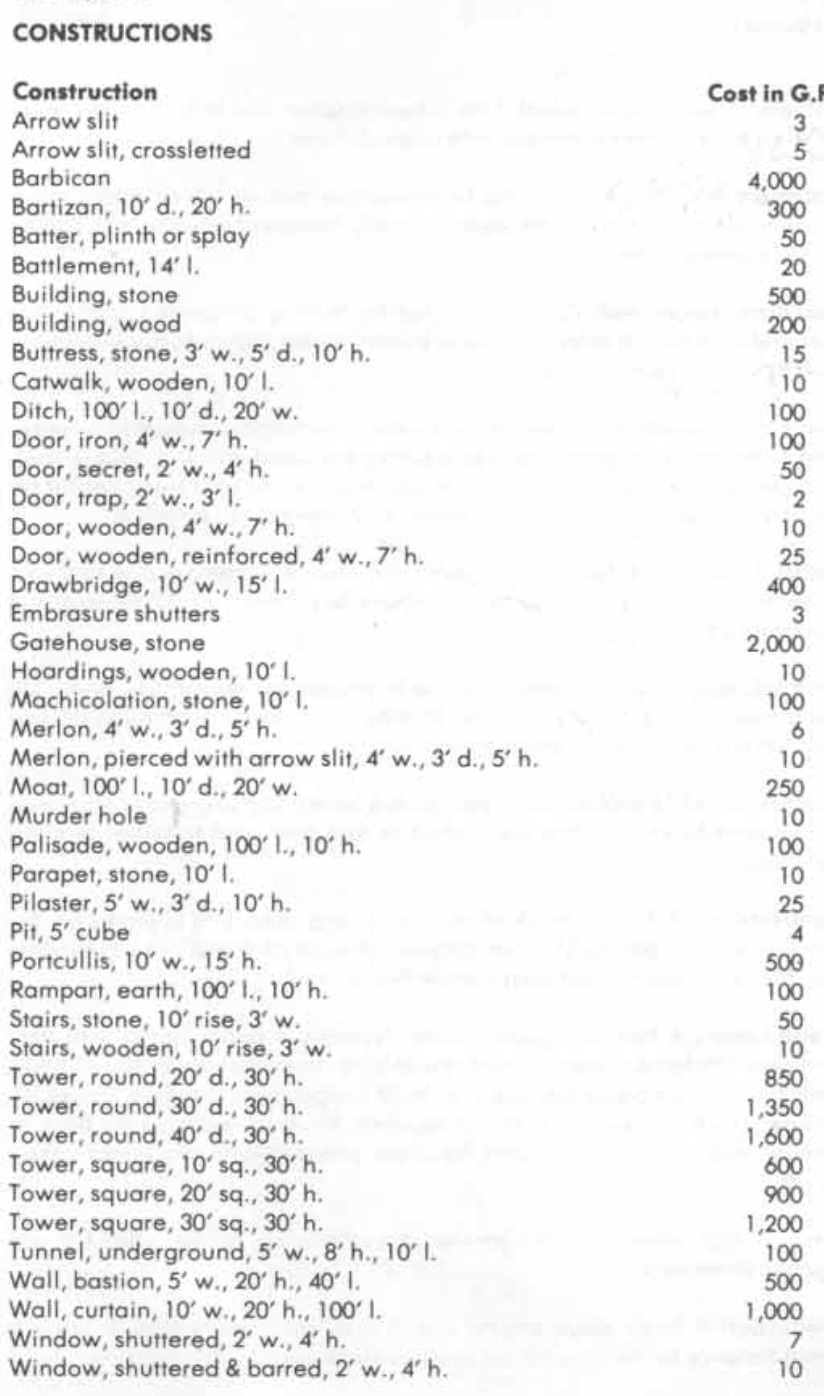
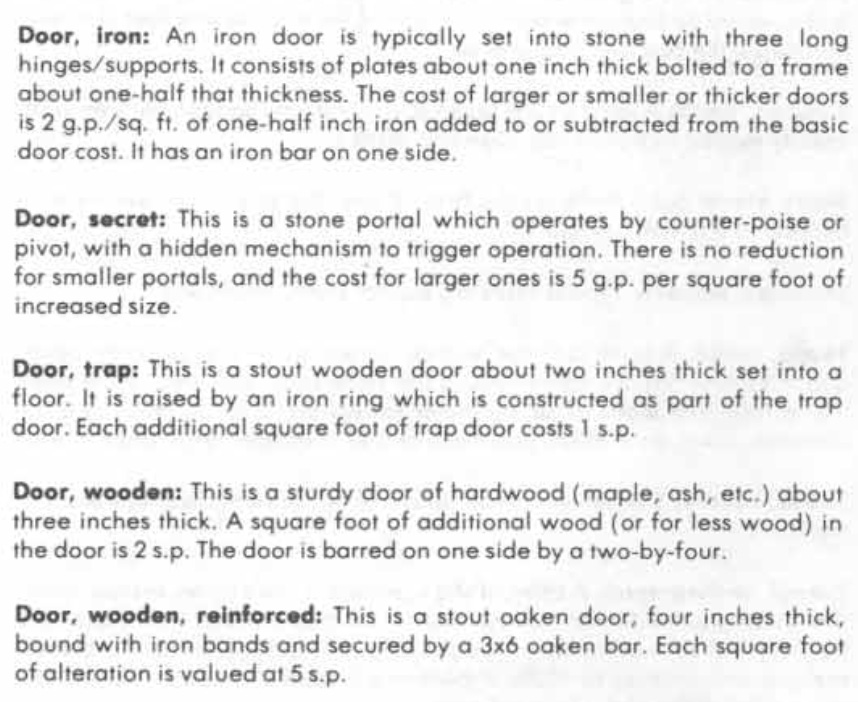
What the domain-level stronghold game promises is that these choices will matter. That is, at some point it will matter whether a particular door in your stronghold is wood, iron, or reinforced. The trap and secret doors will matter. It’s worth the time figuring out if you are going to need extra square feet on a given iron door. Note that these doors don’t come with explicit mechanics; rather, it’s up for the GM to adjudicate how they matter when the times comes.
I can’t speak from experience, because I never built a fictional stronghold (though I did love the tower rules in the 2e Wizard’s Handbook). But I’m a bit skeptical here. Is the GM going to solo play an adventuring party breaking into your castle while the high level PCs are away? Is there going to be a war game scenario where a rival army is breaking down your reinforced-or-not iron-or-wood doors?
Similarly, Rejec has built a game loop with extensive and in fact somewhat byzantine procedures that would seemingly want create interesting risk-reward dynamics. But I do wonder if this is really an engine for gameplay or merely the appearance of it. For example, you could go to great expense to acquire a “prismatic walker” as your vehicle and then augment it with a “porcelain glaze” which covers it “in a reflective glaze that protects from lasers, lazors, and mind-altering rays.” Flavorful...but why would you do this if there is no bestiary of creatures that pelt caravans with lasers or mind-altering rays, let alone rules that tell you how such lasers damage caravans and what the results are? There are a lot of upgrades in the book like this, that on the one hand suggest very thorough combat and exploration mechanics (like you might find in a game like Lancer), while on the other adhere to an OSR style that favors minimalism and GM interpretation. As I have not played his system, I can’t say for sure; maybe it does all fit together cohesively.
I suspect, though, that the abundance of flavor will end up demanding a lot from the GM. As indicated in my example from the 1e DMG, this would be entirely keeping with old school dnd tradition. The extensive charts and tables all work, provided you have a GM who invests the time into actually making the system that the tables imply.
(Oddly, I would say the most robust and complete system (in this sense) I have played within dnd came in 3rd edition, which allowed players to reinvest loot into a concrete and well-defined magic item economy, magic being the thing most players want after all. The wealth by level system sort of made this too balanced, however, so that there were always optimal choices and those choices ended up being incorporated into the system.)
Finally
All that being said, I still think UVG and Rejec’s other projects are amazing. One day I will run a science-fantasy campaign and I will pull heavily from this book. (Actually Luka, if you are reading this, what I would really love is a science-fantasy bestiary. As in, a set of creatures/beings/things that could populate a world of my own making.)